


Video surveillance, AGVs, machine vision, and temporary industrial networks place very different demands on cellular connectivity. Multiple HD cameras create sustained uplink traffic, while AGVs may use less bandwidth but are more sensitive to latency variation, packet loss, mobility, and connection recovery.
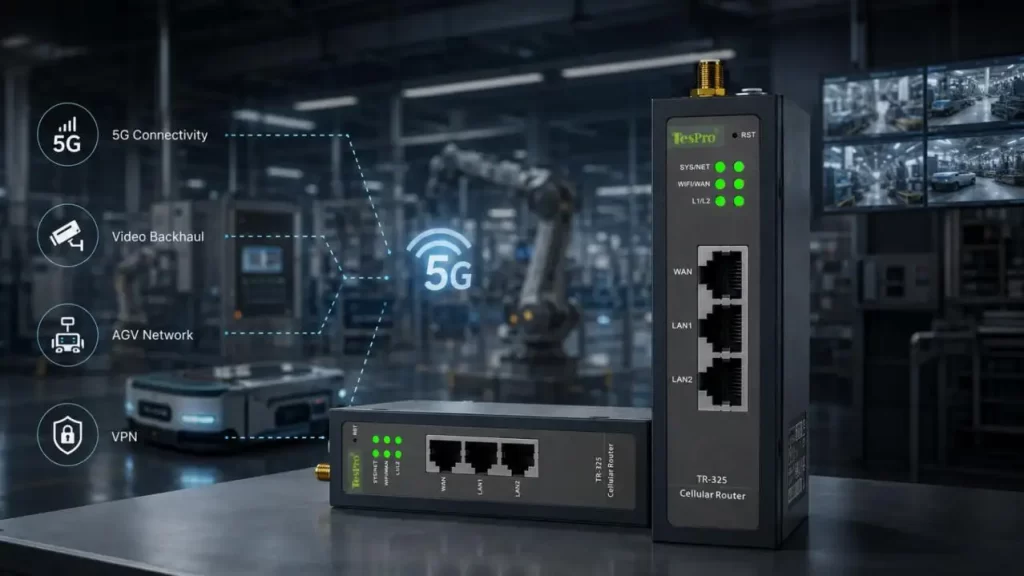
For these applications, selecting a High-Performance Industrial Cellular Router should therefore start with the workload—not simply the theoretical 5G speed printed on a modem specification.
Why Video and AGV Networks Fail Even When 5G Signal Looks Strong
A surveillance system may work with one camera but begin dropping frames when several streams are uploaded simultaneously. The reason is often uplink saturation rather than weak 5G coverage.
A useful starting point is:
Required uplink ≈ active camera streams × actual stream bitrate + protocol/VPN overhead + engineering reserve
H.265 can reduce video bandwidth compared with H.264 in suitable implementations, and ONVIF Profile T supports both formats for advanced IP video systems.
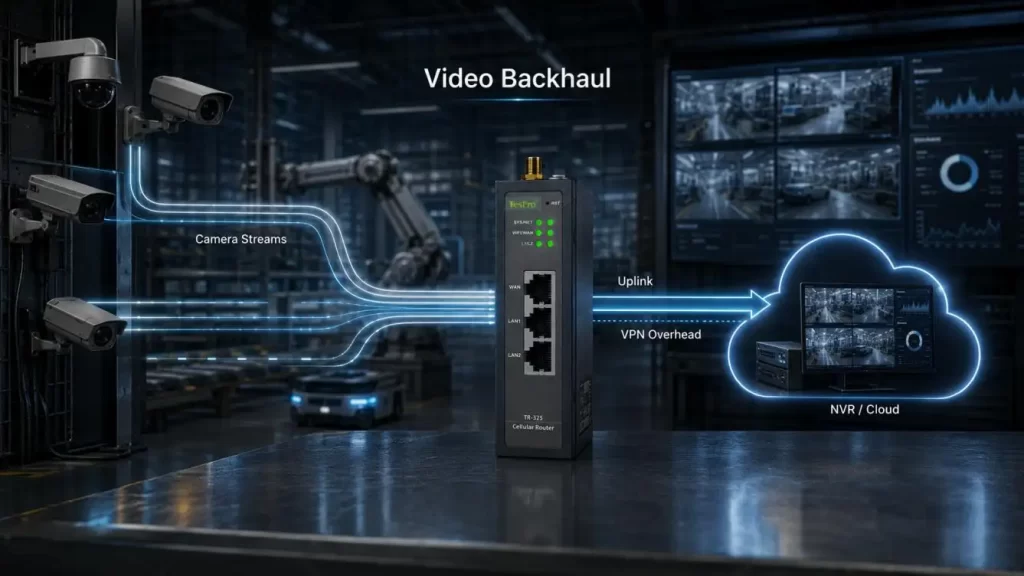
AGV networks present a different problem. Control commands, status updates, navigation data, and alarms may consume relatively little bandwidth, but unstable latency, jitter, packet loss, or handover interruptions can still affect operation. 3GPP TS 22.104 specifically addresses communication requirements for cyber-physical control applications, reinforcing why industrial communication cannot be evaluated from peak Mbps alone.
A High-Performance Industrial Cellular Router should consequently be evaluated against four different questions:
• Is cellular coverage sufficient along the entire operating route?
• Is sustained uplink capacity adequate for video or machine-vision traffic?
• Can Ethernet ports avoid creating a local bottleneck?
• What happens to throughput and recovery behavior when VPN and failover are active?
5G Speed Is Only One Part of Router Performance
A router may contain a high-speed 5G modem while application throughput remains limited elsewhere.
| Performance Layer | What Buyers Should Check |
| Cellular link | 5G bands, coverage, SA/NSA compatibility, uplink performance |
| LAN | Port speed, port quantity, connected cameras/PLCs/NVRs |
| Routing | NAT, firewall and concurrent traffic processing |
| VPN | Encrypted throughput and tunnel recovery |
| RF | RSRP, RSRQ, SINR and antenna installation |
| Redundancy | SIM switching and WAN recovery behavior |
This distinction matters especially for machine vision and video surveillance. A 5G radio link capable of high throughput provides little benefit if cameras are connected through insufficient Ethernet capacity or if encryption processing becomes the bottleneck.
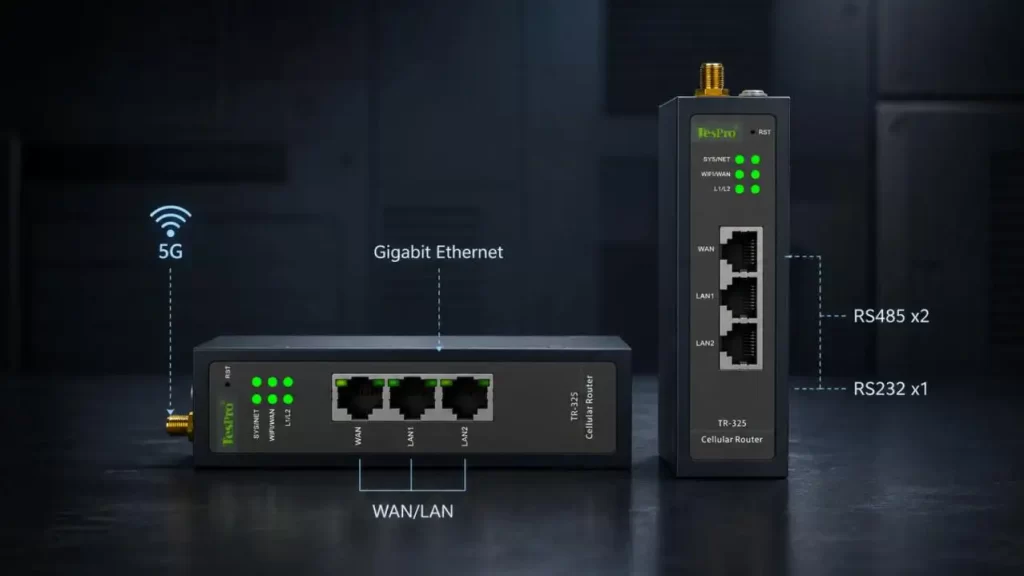
At Tespro, we design our TR industrial router portfolio with different interface requirements in mind. Our 5G TR-225 and TR-245 models provide 100 Mbps-class LAN connectivity, while the TR-325 and TR-345 are available with Gigabit-class Ethernet options for applications that require higher local data throughput. Across the TR series, we also integrate capabilities such as dual SIM, network failover, VPN connectivity, and remote management to support more reliable industrial communications.
For us, port architecture is an important part of selecting a High-Performance Industrial Cellular Router. When multiple cameras, local NVRs, machine-vision controllers, or other Ethernet devices share the same router, we recommend evaluating not only 5G performance, but also Ethernet port speed, port quantity, traffic load, and VPN requirements to avoid creating a bottleneck on the local network.
4G, 5G NSA, 5G SA or Private 5G?
The best network is determined by application requirements rather than generation alone.
| Network Option | Best Evaluation Scenario | Main Consideration |
| 4G LTE | Telemetry, backup links, moderate traffic | Local capacity and coverage |
| 5G NSA | Higher-bandwidth public cellular deployment | Operator coverage and uplink |
| 5G SA | Projects requiring native 5G architecture | Network availability and application requirements |
| Private 5G | Controlled factory or large AGV deployment | Infrastructure cost, coverage and QoS control |
At Tespro, we regard public 5G as a practical choice for applications such as remote video backhaul, temporary industrial networks, and distributed equipment where deploying dedicated radio infrastructure may not be economical. Private 5G becomes more relevant when customers need greater control over factory coverage, device access, network policies, and overall network management.
When we evaluate a 5G deployment, we do not treat 5G as a guarantee of fixed industrial latency or fixed bandwidth. Actual end-to-end performance depends on factors such as radio conditions, network architecture, cell congestion, routing paths, VPN processing, server location, and application behavior. For this reason, we recommend validating performance under the real operating environment rather than relying only on theoretical 5G specifications.
We also distinguish 5G RedCap from a High-Performance Industrial Cellular Router designed for bandwidth-intensive applications. RedCap is intended to reduce device complexity and typically operates with lower bandwidth and simplified antenna capabilities, so it should not be considered a direct replacement for full-performance 5G routers in applications such as multi-channel video transmission, machine vision, or other high-throughput industrial networks.
Dual SIM Does Not Mean Zero-Downtime Networking
Redundancy also requires comparison rather than a simple feature checklist.
Single SIM offers the simplest architecture.
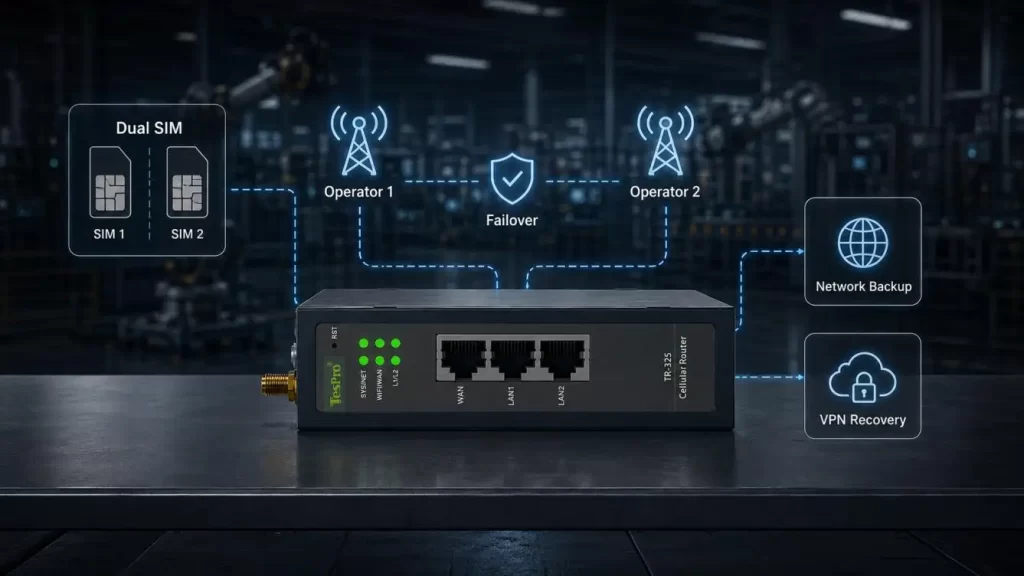
Using one modem per Dual SIM may result in enhanced carrier availability by allowing the other SIM/operator to be selected.
Incorporating Dual modems can support more sophisticated redundancy structures; however, this comes at the cost of increased hardware complexity, power, and cost.
For Dual SIM systems, failover is more complex and can involve detection of the failover condition, registration on the new network, updating of the routing, changing of the IP address, and re-establishment of the VPN. It is recommended that the clients provide specifications on the expected recovery behavior and not assume “zero downtime.”
Tespro integrates dual-SIM standby and network backup functions across our industrial router portfolio to improve cellular redundancy and connection availability. For applications using the TR series, we recommend evaluating failover performance under the actual operator network, VPN configuration, and application environment, since recovery time can vary depending on network registration, routing, and tunnel re-establishment conditions.
Match the Router to Video, AGV and Machine-Vision Traffic
When cameras and AGVs share one High-Performance Industrial Cellular Router, traffic should not automatically receive equal priority.
Video streams create continuous high-volume traffic. AGV control traffic may be smaller but more time-sensitive. Network planning should therefore consider:
• VLAN separation between surveillance and automation devices;
• QoS policies that protect critical AGV traffic;
• Local NVR or edge processing to reduce cellular video upload;
• Sufficient Gigabit Ethernet capacity for high-bandwidth devices;
• VPN capacity under full application load;
• 4G/5G fallback where local coverage requires it.
For temporary industrial networks, construction monitoring, or mobile equipment deployments, 5G may also reduce the need for permanent wired WAN infrastructure.
Antenna Placement and Field Testing Matter as Much as Router Specifications
Before deployment, measure RSRP, RSRQ and SINR throughout the actual installation area or AGV route. Strong received signal alone does not prove that interference or cell loading is acceptable.
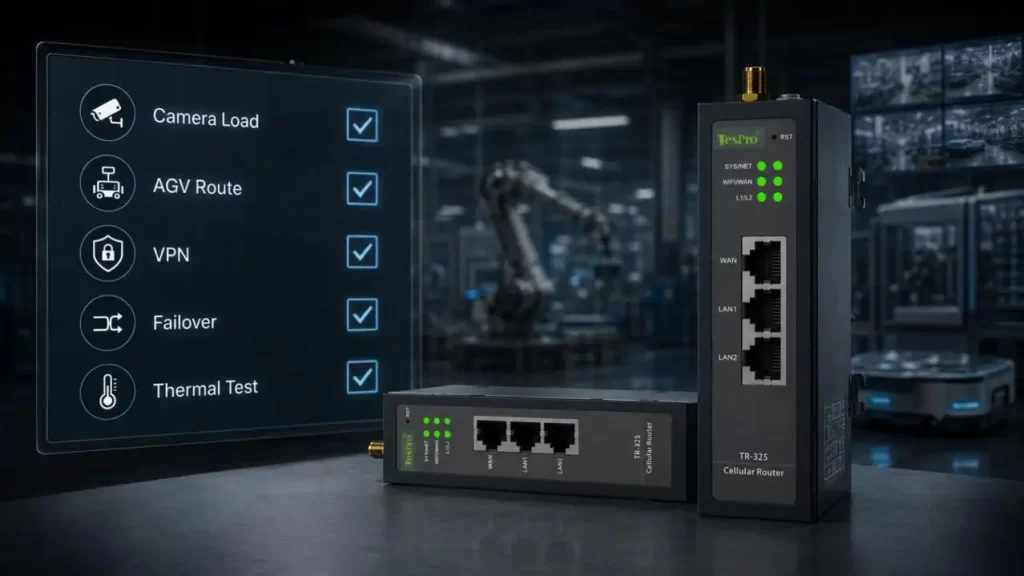
A practical commissioning test should include:
• Simultaneous camera upload
• Loaded VPN throughput
• AGV movement through coverage boundaries
• Packet loss and latency variation
• SIM/WAN failover
• Power interruption and restart
• Watchdog recovery
• Operation at expected environmental temperatures
Tespro's TR-325 and TR-345 5G models, for example, are specified for industrial temperature ranges up to -40°C to +75°C and support wide-voltage industrial power input, but environmental suitability still needs to be matched to the actual enclosure and site conditions.
Verify Standards Before Purchasing
For European projects, radio equipment should be checked against the applicable Radio Equipment Directive 2014/53/EU, covering areas including safety, EMC and radio-spectrum requirements.
Buyers should also verify, where relevant:
• Supported 3GPP release and 5G bands
• SA/NSA and carrier compatibility
• Environmental and EMC test documentation
• Declared cybersecurity or industrial-security compliance
• Actual VPN and failover test conditions
Do not infer certification simply because a router supports VPN, firewalling, industrial protocols, or a rugged enclosure.
Choosing the Right High-Performance Industrial Cellular Router
The final decision should follow a measurable sequence:
Application traffic → cellular coverage → uplink requirement → Ethernet architecture → VPN load → redundancy → environmental validation → compliance.
For connecting systems in industrial temporary networks, machine vision, and AGV applications, this method surpasses the 5G-based router selection method.
The TR series of Industrial Cellular Routers from Tespro offer cellular, Industrial Ethernet and serial, dual-SIM, along with VPN and remote management among their hardware combinations, especially the 5G and Gigabit-Ethernet versions.
We recommend starting each new deployment with an analysis of the actual network requirements, which should include the AGVs, necessary each new deployment with an analysis of the actual network requirements, including the AGVs, needed ports, local 4G/5G coverage, expected failover, and the camera bitrate. This allows us to recommend the most appropriate configuration of the TR-series routers to exactly match the needs of the deployment and avoid over-specification of the routers.
FAQs
Q1. What are the use cases for Tespro's High-Performance Industrial Cellular Routers?
High-Performance Industrial Cellular Routers from Tespro can be used in advanced mobile and high bandwidth industrial networks, such as video surveillance and backhaul, connectivity for autonomous guided vehicles (AGV), autonomous mobile robots (AMR), and machine vision, remote access to industrial equipment, and temporary industrial networks.
Q2. Are Tespro's Industrial Cellular Routers 5G capable?
Tespro's TR-series include models with 5G Industrial Cellular Routers for high cellular bandwidth and industrial Ethernet applications.
Q3. Which Tespro routers are better for high-bandwidth Ethernet applications?
For high bandwidth applications involving multiple high throughput devices such as cameras, Network Video Recorders (NVRs), and machine vision controllers, Tespro offers TR-series models with Gigabit-class Ethernet. Buyers should ensure the appropriate ports for speed and quantity based on the expected throughput.
Q4. Are Tespro's Industrial Cellular Routers usable for video surveillance?
Yes. Tespro's Industrial Cellular Routers support cellular video backhaul. However, buyers should consider camera bitrate, number of concurrent video streams, uplink capacity, VPN overhead, and local Ethernet before choosing a router.
Q5. Can Tespro's 5G routers be used in AGV networks?
Yes. Tespro 5G routers are applicable in AGV networks and other mobile industrial networks where cellular coverage, mobility, VPN, and networks redundancy are needed. Actual performance for latency, jitter, packet loss, and handover will need to be evaluated on site.