工业蜂窝路由器
Product ID: TR-444
TR-444工业路由器由Tespro独立开发,支持全球2G/3G/4G网络、千兆以太网(1*WAN 2*LAN)和双频Wi-Fi 4/6。配备1*RS232、2*RS485和4*GPIO接口,并支持Modbus/BACnet,确保物联网和工业自动化的可靠连接。
-
网络
2G / 3G / 4G
-
界面
1*WAN 4*LAN 10 / 100 / 1000Mbps
-
Wi-Fi
Wi-Fi 4(802.11b/g/n)/ Wi-Fi 6(802.11a/b/g/n/ac/ax)
-
串口与输入输出
1*RS232 2*RS485 4*GPIO
立即获取免费报价
下载

TR-344 工业路由器视频
TR-444工业LTE路由器展现了可靠的4G/LTE连接能力、工业耐用性、安全网络以及自动化智能物联网设备和现场部署的可靠远程连接。
Features
核心优势

4G/3G/2G 及双卡/eSIM
支持多样化蜂窝网络接入(2G/3G/4G/5G),支持Cat1/Cat4/Cat6等4G LTE选项。配备双SIM和双eSIM功能,实现灵活切换和链路备份。

千兆以太网接口与Wi-Fi
配备支持广域网/局域网自动感应的千兆以太网端口,并具备双频Wi-Fi 4(2.4GHz)和Wi-Fi 6(5GHz)能力,结合高速有线传输与便捷的无线接入,满足工业设备连接、数据传输和现场网络的需求。

集成串行和GPIO接口
集成设计采用串口(1*RS232,2*RS485)和4*GPIO接口,便于工业设备的连接,并实现数字(开/关)输入和输出的控制。

TesproOS 系统与远程运维
配备专有的 TesproOS 操作系统和可视化的基于网页的管理仪表盘,支持全生命周期设备管理。支持实时集群状态监控、远程批处理参数配置、日志诊断及基于云的 OTA 固件升级;结合多层 VPN 加密,实现高效的运维,无需现场访问。

丰富的协议生态系统
它集成了北向云连接(MQTT/OPC UA)、工业现场总线(Modbus/ProfiNet)以及行业专用的电力和能源存储协议(DLT645/IEC61850)。结合强大的OpenVPN/IPSec加密和快速定制协议开发能力,简化了设备上线流程——实现即插即用功能——并加速了OT与IT数据的融合。

卓越的耐候性
它支持从-40°C到75°C的宽阔工作温度范围,以及5%至95%相对湿度的非冷凝湿度,并具备IP30防护等级,能够可靠应对复杂且恶劣的工业环境——包括高海拔、高温和高压——以确保设备稳定运行。
Tech Specs
工业路由器规格表
硬件规格
| 类别 | TR-444 |
| 硬件系统 | |
| 中央处理器 | 双核Cortex-A53处理器,主频为1.3GHz |
| 内存 | 512 MB,DDR3 |
| 闪电侠 | 256 MB |
| 网络接口 | |
| 以太网端口 | 5 x 10 / 100 / 1000Mbps |
| 蜂窝网络 | 4G LTE:Cat1 / Cat4 / Cat6;5G NR:eMBB/RedCap |
| 万 | 1 x WAN 10 / 100 / 1000Mbps |
| 局域网 | 4 x LAN 10 / 100 / 1000Mbps |
| SIM 卡槽 | 双SIM卡 / 双eSIM / 1×SIM 1 ×eSIM |
| 天线 | SMA公头(外螺纹,内孔);天线端口:4个 |
| 物理接口 | |
| 接地终端 | 1 × 接地螺丝 |
| 状态指示器 | 6个角色 |
| 重置按钮 | 1个 |
| 工业界面 | |
| 串口 | 2台RS485,1台RS232,3kV高压隔离线 |
| 输入输出接口 | 支持4×输入输出;DI/DO可配置 |
| Wi-Fi 无线网络 / WLAN | |
| Wi-Fi频率 | 2.4GHz,5GHz |
| 协议标准 | Wi-Fi 4:802.11b/g/n;Wi-Fi 6:802.11a/b/g/n/ac/ax |
| 最大传输率 | AX3000 |
| 数据速率 | 802.11b/g/n:最高574 Mbps;802.11a/b/g/n/ac/ax:最高2402 Mbps |
| 发射功率 | 802.11b:16 dBm ±2 dBm (11Mbps);802.11g:16 dBm ±2 dBm (54Mbps);802.11n@2.4GHz:16 dBm ±2dBm (HT20 MCS7);802.11n@2.4GHz:16 dBm ±2 dBm(HT40 MCS7) |
| 传输距离 | 视线距离≤100米(实际距离取决于现场环境) |
| 电源 | |
| 电源接口 | 直流电源接口:1个(DC2.1) |
| 输入电压范围 | 直流电源:12–36V;支持反极性保护 |
| PoE(可选) | 支持 PoE 电源;兼容 IEEE 802.3af / IEEE 802.3at(PoE)标准 |
| 备用电源 | 120mA–200mA@12V |
| 工作功率 | 150mA–320mA@12V |
| 峰值功率 | 320mA@12V |
| 环境条件 | |
| 工作温度 | -40°C到75°C |
| 工作湿度 | 5%到95%(非凝缩) |
| 储存温度 | -40°C到80°C |
| 机械规格 | |
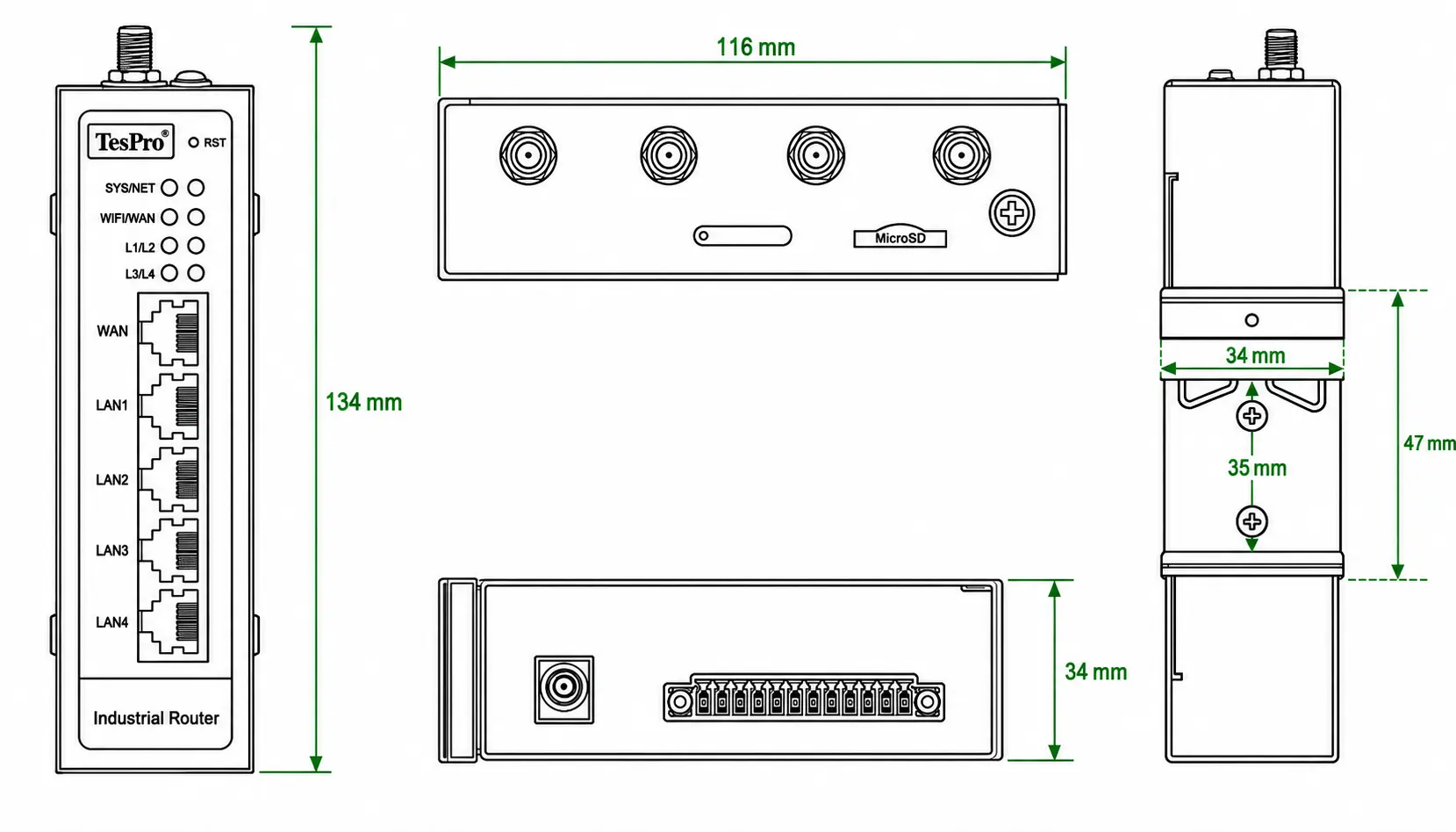
| 产品尺寸 | 116 × 134 × 34 毫米(包括天线连接器) |
| 防护等级 | IP30 |
| 住房 | 金属外壳 |
| 安装方法 | DIN轨道 / 壁挂式 |
| 冷却方法 | 无风扇冷却 |
| 产品重量 | 450克 |
| 可靠性 | |
| 震惊 | IEC60068-2-27 |
| 振动 | IEC60068-2-6 |
| 掉落 | IEC60068-2-32 |
| 认证与标准 | |
| 监管认证 | CE,RoHS |
| EMC 标准 | EN 55032;EN 55035;EN IEC 61000-6-3:2021;EN IEC 61000-6-1:2019;EN 301489-1;EN 301489-17;EN 301 489-52 |
| 射频标准 | EN300328;EN301893;EN301511;EN301908-1/-2/-13 |
| 搜救安全 | EN50665;在IEC62368-1中 |
| 网络 | EN18031-1;EN18031-2 |
| 静电放电(ESD) | EN 61000-4-2:2009 |
| 辐射免疫 | EN IEC 61000-4-3:2020 |
| 爆发(EFT) | EN 61000-4-4:2012 |
| 浪涌 | EN 61000-4-5:2014 A1:2017(以太网端口) |
| 传导免疫 | EN 61000-4-6:2014 |
| 振荡波免疫 | EN61000-4-12,3级 |
| 磁场抗扰 | EN61000-4-8,水平/垂直400A/m(>级2) |
软件规范
| 类别 | TR-444 |
| 工业协议与数据能力 | |
| 工业协议 | 包括Modbus RTU、Modbus TCP、BACnet、Mbus、OPC UA及多种其他协议 |
| Modbus | Modbus RTU,Modbus TCP |
| 工业设备协议 | ProfiNet,EtherCat,EtherNet(可选) |
| BACnet | BACnet |
| OPC UA | OPC UA |
| 电表协议 | DLT 645-2007、IEC 1107、IEC 61850、IEC 62056-21、DLMS |
| DN3 | 支持的模式:站点、外站;连接方式:TCP |
| DLMS/COSEM | DLMS |
| Modbus 自定义寄存器 | Modbus TCP 定制寄存器模块请求,能够在路由器内读写文件,扩展 Modbus TCP 客户端功能 |
| 支持的数据格式 | INT/UINT(8/16/32位),32位浮点,十六进制,ASCII;支持MSB/LSB和字节顺序转换(ABCD/DCBA/CDAB/BADC) |
| DTU功能 | 支持TCP/UDP透明传输;支持Modbus RTU转换为Modbus TCP;支持DCTCP/DCUDP模式 |
| 数据到服务器 | HTTP(S)/MQTT/Azure MQTT;多源数据报告;最小1秒间隔;Lua脚本 |
| Modbus / MQTT 网关 | 允许通过MQTT代理向Modbus服务器发送命令并接收数据 |
| API / Web API | 支持网络Web API;用于获取或更改数据的API端点 |
| 网络能力 | |
| 网络接入 | 2G/3G/4G 蜂窝网络(或 VPDN 专用网络) |
| 访问认证 | 支持CHAP/PAP认证 |
| 局域网协议 | ARP,以太网 |
| WAN协议 | PPP、PPPoE、DHCP;TCP、UDP、IPv4、IPv6、ICMP、NTP、DNS、HTTP、HTTP、SFTP、FTP、SMTP、SSL/TLS、ARP、VRRP、PPP、PPPoE |
| 网络协议 | UPnP、SSH、DHCP、TELNET、SMPP、SNMP、MQTT |
| 布线 | 静态路由,OSPF动态路由 |
| NAT | DMZ、NAT、NAT-T、NAT64(在防火墙下列出) |
| DHCP | 静态和动态IP分配、DHCP中继、DHCP服务器配置、状态、静态租约;支持通配MAC地址 |
| 网络备份/故障切换 | Wi-Fi WAN、VRRP 和有线连接选项;这些都可作为自动故障切换解决方案使用 |
| 服务质量 | 基于源/目的、服务、协议或端口的流量优先队列;WMM,802.11 |
| 知识产权应用 | 支持 Ping、Traceroute、DHCP 服务器、DHCP 中继、DHCP 客户端、DNS 中继、DDNS、Telnet |
| DNS/DDNS | 支持DoH(基于HTTPS的DNS);多种DDNS服务提供商配置及手动定制 |
| Wi-Fi | |
| 无线模式 | Wi-Fi 4:802.11b/g/n;Wi-Fi 6:802.11a/b/g/n/ac/ax;支持接入点(AP)和站点(STA)模式 |
| Wi-Fi 安全 | WPA2-企业/PSK,WPA-EAP/PSK,WPA3-SAE/EAP,OWE;AES-CCMP,TKIP,客户端分离,EAP-TLS,802.11w PMF等 |
| 最大Wi-Fi客户端 | Wi-Fi 4:最多30个同时连接;Wi-Fi 6:最多256个同时连接 |
| 热点中继 | 将Wi-Fi热点登录页面转发给后续连接的设备(强制门户中继) |
| SSID / ESSID | SSID隐形模式;基于MAC地址的访问控制 |
| 操作模式 | 支持AP、客户端和WDS(无线分发系统)模式 |
| 安全特征 | 开放系统,共享密钥,WPA/WPA2认证;WEP/TKIP/AES加密 |
| 网络安全与 VPN | |
| 网络保护安全 | 端口转发/流量规则/自定义TTL;WebUI/CLI防火墙配置;DMZ,NAT/NAT-T/NAT64 |
| 数据保护安全 | 支持包括 PPTP、L2TP、GRE、IPSEC VPN、DMVPN、OPENVPN、WireGuard 等 VPN 等 VPN 功能;支持数字证书 CA |
| 认证 | 预共享密钥、X.509证书、TACACS、RADIUS(内置/外部)、IP/时间/登录阻断、随机密码生成器 |
| 攻击防护 | DDoS防护(SYN洪水、SSH、HTTP/HTTP);端口扫描保护(SYN-FIN、SYN-RST、X-mas、NULL、FIN) |
| VLAN | 基于端口和基于标签的VLAN隔离 |
| 访问控制 | SSH、Web UI、CLI 和 Telnet 的灵活访问控制 |
| 网页过滤 | 不想要的网站的黑名单;仅允许的网站的白名单 |
| 证书管理 | 证书生成工具;可以创建CA、服务器、客户端、Let's Encrypt和SCEP证书 |
| OpenVPN | 支持多个客户端和一台服务器同时使用;支持27种加密方法 |
| IPsec | XFRM、IKEv1、IKEv2;IPsec 的14种加密方法:3DES、DES、AES128、AES192、AES256、AES128/192/256 GCM8/12/16 |
| WireGuard | 支持 WireGuard VPN 客户端和服务器 |
| GRE | 支持GRE隧道,基于IPsec的GRE隧道 |
| PPTP / L2TP | 客户端和服务器实例可以同时运行;支持 L2TPv3,L2TP over IPsec |
| DMVPN | 可扩展IPsec VPN;支持第二阶段、第三阶段和双中枢 |
| SSTP | 支持 SSTP 客户端实例 |
| 零级 | 支持零级VPN客户端 |
| 隧道 | 通过代理为现有客户端和服务器添加TLS加密 |
| 我有 | 隧道内的加密、认证和压缩;支持客户端和服务器模式 |
| EoIP | 基于GRE RFC 1701的IP以太网隧道 |
| 管理与平台 | |
| 配置方法 | Web UI、CLI、SSH、JSON-RPC、TesproOS 等 |
| 云与物联网平台 | 支持谷歌、华为、亚马逊、Microsoft Azure、iStarOS、Azure IoT Hub、其他第三方云平台及定制云 |
| FOTA | 服务器固件更新,自动通知 |
| SNMP | SNMP(v1、v2、v3),SNMP陷阱 |
| MQTT | MQTT 经纪人,MQTT 出版人 |
| JSON-RPC | 基于HTTP/HTTPS的管理API |
| SSH | SSH(v1,v2) |
| 升级方法 | FOTA;网页界面 |
| 日志功能 | 事件日志、系统日志、内核日志 |
| 警报功能 | 电子邮件状态提醒 |
| 按需激活 | 按需拨号、数据激活、短信激活 |
| 电子邮件 | 接收来自各类服务的电子邮件状态提醒 |
| 软件系统 | |
| 操作系统 | TesproOS(Linux) |
| 支持的语言 | 忙碌箱壳,Lua,C,C,Python |
| 开发工具 | SDK包,包括构建环境 |
| 固件定制 | 支持自定义品牌固件和网页应用(颜色、标志等) |
| 包管理 | 支持安装额外软件包 |
| 固件与配置 | |
| 网页界面升级 | 从文件更新固件,检查服务器上的固件,配置文件,配置文件备份 |
| FOTA升级 | 固件更新 |
| 云大批量升级 | 支持通过 TesproOS 系统同时更新多个设备的固件/配置 |
| 配置保留升级 | 更新固件时不丢失当前配置 |
| 恢复出厂设置 | 完全恢复出厂设置,恢复包括 IP 地址、PIN 码和用户数据在内的所有系统设置 |
| 环境与可靠性 | |
| 热备份 / VRRP | VRRP(列在网络备份下) |
| 在线链接检测 | 发送心跳包进行检测;断开连接时自动重新连接 |
| 双SIM链路切换 | 支持双SIM或双eSIM链路切换 |
| 内置看门狗 | 设备自检技术;运行时故障自动自我恢复 |
Product Details
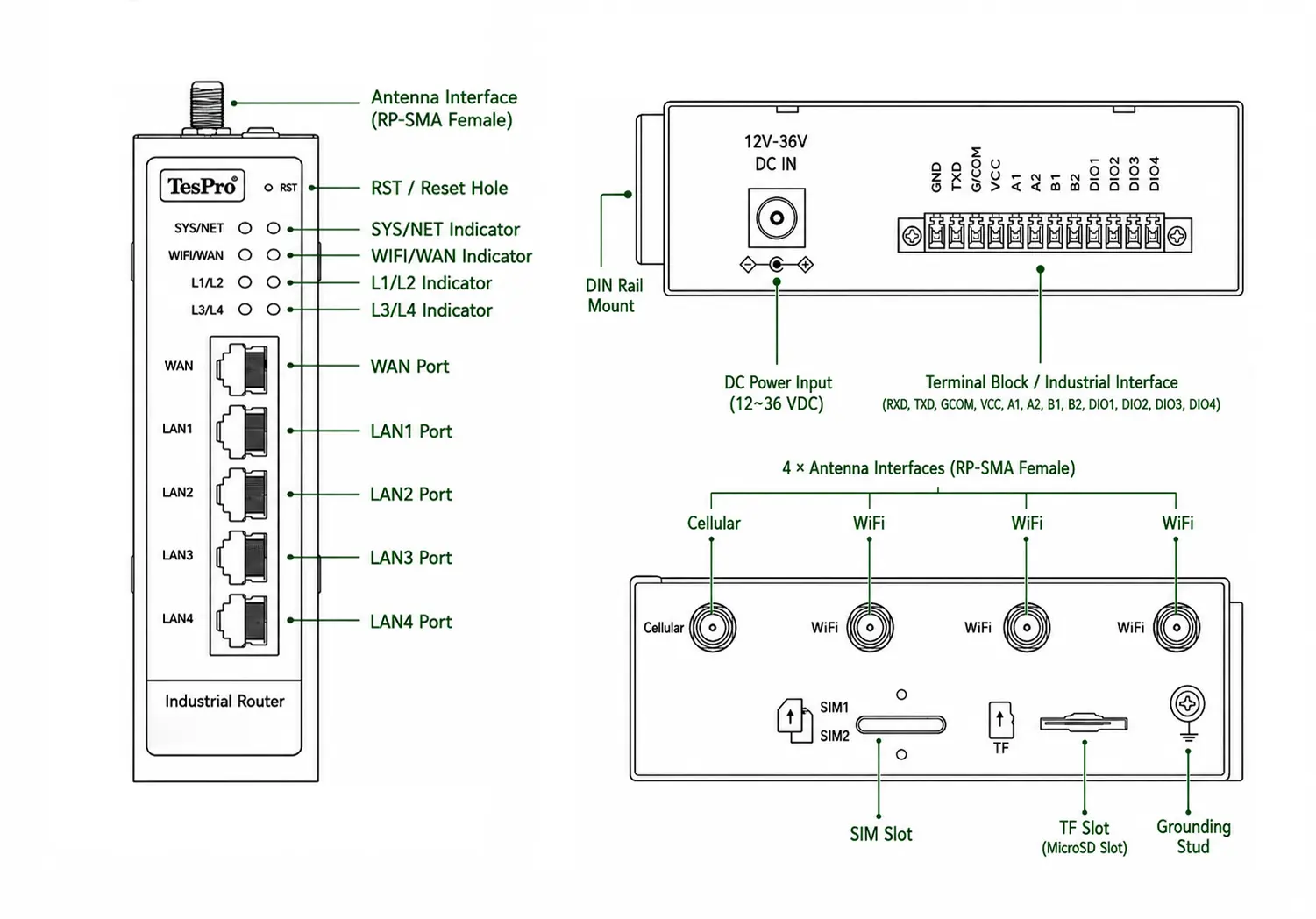
接口图
尺寸图
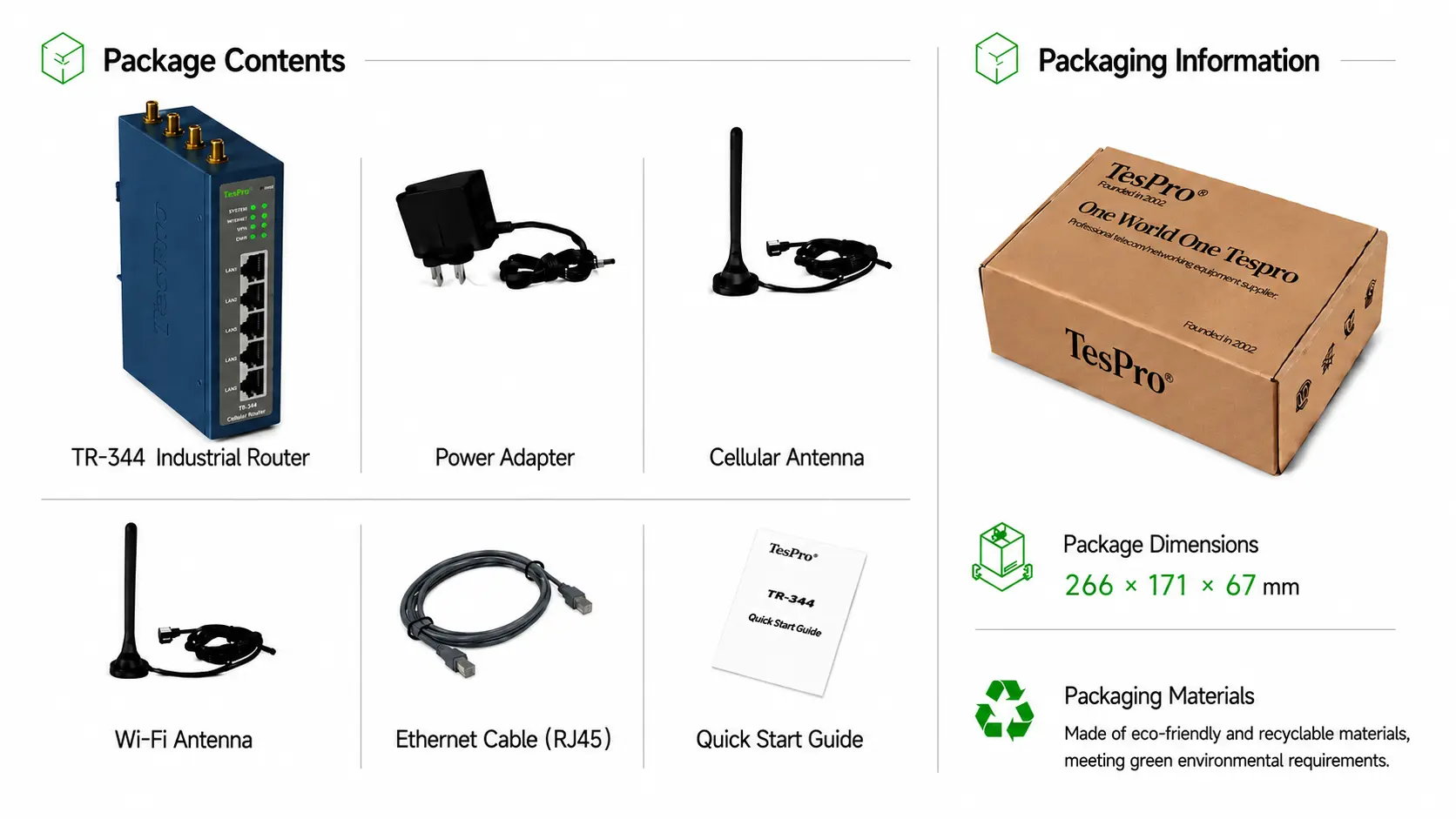
配件图
Explore our Solutions
工业连接与网络解决方案
提供强大的蜂窝和以太网网络解决方案,设计以保证多样化工业场景下可靠的数据传输
Download Materials
常见问题解答
为了帮助您更好地了解我们产品的性能、兼容性和使用情况,我们整理了常见问题解答。如果您的问题未列在下方,欢迎直接联系我们寻求进一步帮助。
联系我们
-
What network and communication methods do TR300-Class industrial routers support?

-
The core value of this series is connecting field devices to carrier cellular networks while providing local Ethernet and Wi-Fi connectivity. Using representative models from the official website as examples, TR-324 corresponds to 4G LTE and TR-325 to 5G LTE; the product-series catalog also covers different cellular generations. For multinational projects, support for local 2G/3G fallback, specific LTE/5G bands, carrier certification, and APN configuration should be confirmed in writing by sales according to the target country and module version.
1. Cellular network: TR-324 is designed for 4G LTE, while TR-325 is designed for 5G LTE. If a project requires multi-mode fallback or specific frequency bands, the target region, carrier, and module configuration must be verified.
2. Wi-Fi: The representative model pages list IEEE 802.11 a/b/g/n/ac and cover the 2.4 GHz and 5 GHz bands. Dual-band Wi-Fi can be used for nearby maintenance, local terminal access, or as a backup link; actual throughput varies with the chipset, channel bandwidth, environment, and model.
3. Wired Ethernet: Gigabit LAN is suitable for connecting PLCs, industrial switches, cameras, HMIs, edge devices, or local maintenance PCs to the same network.
4. Redundancy concept: Representative model pages mention dual-SIM standby and backup switching among wired, Wi-Fi, and cellular links. Dual SIM does not mean every model supports eSIM or automatic dual-carrier strategies; projects must confirm the SIM slots, switching policy, and service plan.
-
What interfaces do TR300-Class industrial routers provide, and how are field devices connected?
-
Representative models typically combine “cellular uplink + Gigabit Ethernet + industrial serial ports.” For devices such as energy meters, PLCs, variable-frequency drives, and environmental sensors, Ethernet, RS485, or RS232 can be selected according to the device interface. Routers are better suited to providing connectivity, forwarding, remote maintenance, and local network management; complex protocol acquisition/conversion requirements can be addressed together with an industrial gateway or protocol converter.
1. Ethernet ports: The top sections of the TR-324/325 pages both list a 2×LAN Gigabit configuration; the specification sections also contain descriptions of LAN0 supporting WAN/LAN auto-adaptation and three Gigabit LAN ports. The inquiry should therefore clearly specify “WAN/LAN quantity, Gigabit/100 Mbps, and whether switching is supported.”
2. Serial ports: The pages confirm RS485- and RS232-type interfaces for common industrial field devices. The exact port quantities are not presented consistently, so the BOM should explicitly lock down the number of RS485/RS232 ports, terminal definitions, isolation requirements, and termination-resistor requirements.
3. SIM and antennas: Representative model pages list dual-layer SIM slots and SMA antenna connectors. The quantity and gain of cellular and Wi-Fi antennas should be confirmed together with site coverage, cabinet installation, and lightning-protection requirements.
4. Power and installation: Representative models are rated for DC 12–36 V and include DC power input, reset, and status indication. The product introduction also describes DIN-rail mounting for deployment inside control cabinets.
-
What are the key technical advantages of TR300-Class industrial routers?
-
The advantage of TR300-Class routers is not simply “Internet access,” but the combination of cellular WAN connectivity, field-device access, network redundancy, and industrial environmental adaptability in an engineering-ready connection node. The following six points are suitable for websites, proposals, or customer inquiry responses, but the product-selection note “confirm by model” should be retained.
1. Multi-mode cellular access: 4G or 5G models meet different bandwidth and latency requirements, while dual-SIM and multi-network redundancy can be confirmed on a project basis.
2. Gigabit local networking: Representative models provide Gigabit Ethernet for industrial switches, edge terminals, and local maintenance networks.
3. Industrial serial connectivity: RS485/RS232 helps connect legacy PLCs, meters, controllers, and smart meters, reducing the need for additional interface converters.
4. Remote network operation and maintenance: The router section of the official website mentions VPN support and remote management. The VPN types actually available, account permissions, remote upgrade functions, and platform capabilities must be confirmed according to the software version, project architecture, and security policy.
5. Link-continuity design: Representative pages mention dual-SIM standby and backup switching among cellular, Wi-Fi, and wired links to reduce the impact of a single unavailable network on data backhaul.
6. Adaptability to harsh environments: The TR-324/325 pages list operation from -40°C to +75°C, 5%–95% non-condensing humidity, and wide-voltage DC 12–36 V, making them suitable for industrial cabinets, protected outdoor enclosures, and utility facilities. For high-altitude, high-humidity, high-salt-fog, or high-voltage environments, product certification and enclosure-system design must be confirmed separately.
-
What are the main application scenarios for TR300-Class industrial routers?
-
This series is particularly suitable for projects where “devices are distributed, on-site service is costly, and stable wide-area network backhaul is required.” The following six categories are typical directions; actual solutions should first complete signal testing, network-security design, power-supply evaluation, and protocol integration testing.
1. Industrial automation: Connect PLCs, HMIs, variable-frequency drives, or production-line control networks to enable status viewing, remote maintenance, and cross-site data backhaul.
2. Smart buildings: Connect building controllers, energy meters, HVAC plant rooms, or BMS subnets to upper-level platforms.
3. Outdoor environmental monitoring: Provide cellular backhaul for weather, dust, water-quality, and station sensors; waterproof enclosures, surge protection, and antenna solutions are also required.
4. Intelligent transportation: Used for distributed network nodes such as roadside equipment, parking systems, bus stops, and traffic monitoring.
5. Smart energy and power: Connect electricity meters, distribution monitoring devices, PV inverters, or energy-storage subsystems and transmit data to a central platform.
6. Smart robots and mobile equipment: Provide cellular network access for mobile or remote equipment in warehouses, campuses, construction machinery, and similar scenarios; bandwidth, roaming, coverage, and security policies must be validated on site.
-
Which protocols and systems are TR300-Class industrial routers suitable for?
-
Representative model pages list multiple power-metering and industrial protocols, including DL/T 645-2007, IEC 62056-21, IEC 1107, IEC 61850, DLMS, as well as Modbus RTU, Modbus TCP, BACnet, M-Bus, and OPC UA. Note that the router’s fundamental role is network transmission and remote connectivity. Whether it can “directly parse, acquire, or convert” a specific protocol also depends on the purchased model’s software functions, the peer device, mapping rules, and the project integration method.
1. When an existing host computer, edge gateway, or platform performs protocol parsing, the router can provide stable cellular backhaul and local network access.
2. When multi-device acquisition, offline caching, edge logic, and large-scale protocol adaptation are required, prioritize evaluation of the TG series industrial gateways.
3. When explicit data mapping between BACnet and Modbus, or OPC UA and Modbus, is required, prioritize evaluation of the TC-100 protocol converter.
4. Before purchasing, provide the device protocol manual, point list, baud rate/parity settings, network topology, security requirements, and target-platform interface so that feasibility can be confirmed.
-
How are warranty, pricing, and purchasing handled for TR300-Class industrial routers?
-
The official product pages provide “Request a Quote” and sales contact options, but do not publish a uniform standard warranty period, retail prices for all SKUs, or extended-warranty terms. Therefore, external publications should state that details are “subject to the written sales quotation, order, and contract,” and should avoid presenting an unpublished one-year warranty or 2–5-year extended warranty as an established commitment.
1. Warranty and extended warranty: It is recommended to provide sales with the model, quantity, deployment country, project environment, service-response requirements, and spare-parts requirements, and request written quotations for the standard warranty, 2–5-year extended warranty, or project services.
2. Pricing and samples: Small-quantity samples can be viewed through the Tespro Online Shop; bulk purchases, OEM/ODM, specific frequency bands, custom protocols, or project packages should be formally quoted by sales.
3. Contact sales: The sales quotation email is sales@tespro.com; the general inquiry email is info@tespro.com. The official website lists telephone/WhatsApp numbers +852 4609 4648 and +1-213 610 4797.
4. Learn more: Products, cases, and demonstrations can be viewed through Tespro’s official Facebook, LinkedIn, YouTube, TikTok, X, and Instagram accounts. The official datasheet and written response should be treated as the final technical reference.
5. Inquiry recommendation: Including the model, country/carrier, quantity, network bands, SIM plan, interfaces, protocols, temperature/humidity and enclosure requirements, lightning protection, certification, lead time, and after-sales requirements in the email can significantly improve product-selection and quotation efficiency.