A remote water pumping station may lose cellular communication after an overnight power outage, even though its router is rated for subzero operation. The problem often appears during restart rather than normal operation. Cold electronic components, temporary voltage drops, and modem initialization create electrical conditions that are absent once the system is running.
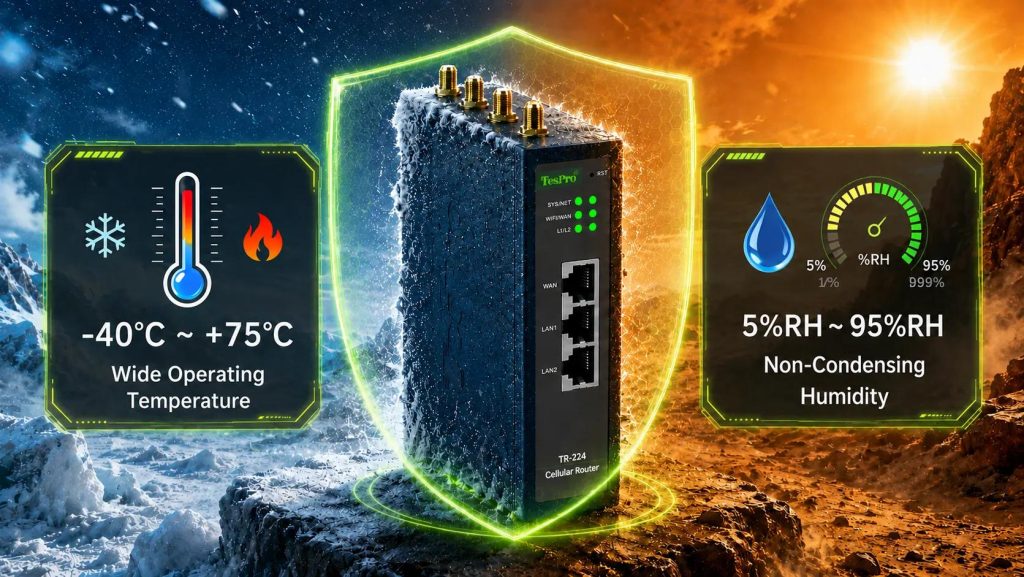
Selecting a Rugged Industrial Router for Harsh Environments requires examining these operating transitions, not just the temperature limits printed on a datasheet.
The Tespro's TR-224 industrial cellular router is capable of functioning in temperature ranges of -40°C to +75°C. While this range is suitable to make an initial equipment selection for remote telemetry and industrial monitoring, actual equipment reliability is impacted by a number of other factors including the type of power source, the design of the enclosure, and the behavior of the cellular network.
1. Why Does the Installation Temperature Matter More Than Outdoor Weather?
The temperature inside an electrical cabinet is very different from the outdoor ambient temperature.
The electrical cabinet is continuously heated by solar radiation and heat from nearby power supplies and control equipment. If the airflow is restricted, the air around the equipment gets hotter than the outdoor ambient temperature.
Also, heat generated by the internal circuitry must pass through the mechanical structure before it can dissipate to the surrounding air.
There are three factors to examine:
• Local air temperature: The temperature immediately surrounding the router.
• Heat generation: Heat losses in the equipment caused by processing (electrical) work.
• Mounting: The spacing of equipment and the orientation of the enclosure.
A +75°C operating rating should not be interpreted as permission to install the router inside a cabinet where local temperatures exceed that limit.
For outdoor monitoring installations, cabinet-level temperature measurements are more useful than regional weather records.
2. What Happens When a 4G Router Starts at -40°C?
Cold startup is an electrical and communication problem as much as a thermal one.
At low temperatures, electrolytic capacitors may have an increased equivalent series resistance. In some circuits, this may affect the voltage stability of the system during the initialization of the processor and the cellular modem.
Some additional constraints may be due to an external DC power supply. Long power cables may create a voltage drop across a resistive load, and a power supply operating near its current limitation may not be able to meet the demand.
If the voltage at the router input drops sufficiently, the equipment may restart repeatedly, or may not be able to fully initialize the modem.
Cold-Start Failure Modes
• Repeated Boot Cycles: Temporary instability of the power supply causes the equipment to enter a boot cycle from which it is unable to exit.
• Incomplete Modem Initialization: The main processor successfully initializes, but the cellular modem does not.
• Delayed network registration: Device requires more time to detect and attach to the carrier network.
• Failed session recovery: Router registers but application traffic is not restored.
These symptoms call for different remedial actions.
Failure of network registration should not be assumed to be a case of hardware failure before checking SIM, carrier, and antenna conditions, and modem logs.
What Should Be Tested?
An appropriate cold-start procedure includes un-powering the router and bringing it to the required low operating temperature.
After power is applied, the following should be recorded: input voltage, startup current, boot completion, network registration, exchange of data with remote server and restoration of application communication, as evidenced by more than just a status light.
3. How Does High Temperature Affect Continuous LTE Transmission?
The TR-224 employs a dual-core network processing platform and offers 4G FDD-LTE and TD-LTE.
There are many activities that make a processor hot; i.e. floating point math and cellular transmission.
In the presence of a weak signal condition, the modem may need to operate at a higher power level and/or engage in retransmissions, which increases the router's electrical load.
At elevated temperatures, insufficient thermal margin may result in:
• Thermal protection of processor and/or modem.
• Thermal protection of voltage regulator.
• Intermittent loss of cellular connection.
• Premature failure of components due to prolonged thermal stress.
Continuous operation at the upper temperature does not guarantee that all networking functions are operated with identical performance.
For demanding applications, engineers should test sustained traffic, routing, and any required VPN functions under representative thermal conditions.
The temperature at which protective behavior occurs, and whether sustained throughput is guaranteed, should be confirmed with Tespro for the selected hardware configuration.
4. Which TR-224 Specifications Affect Environmental Reliability?
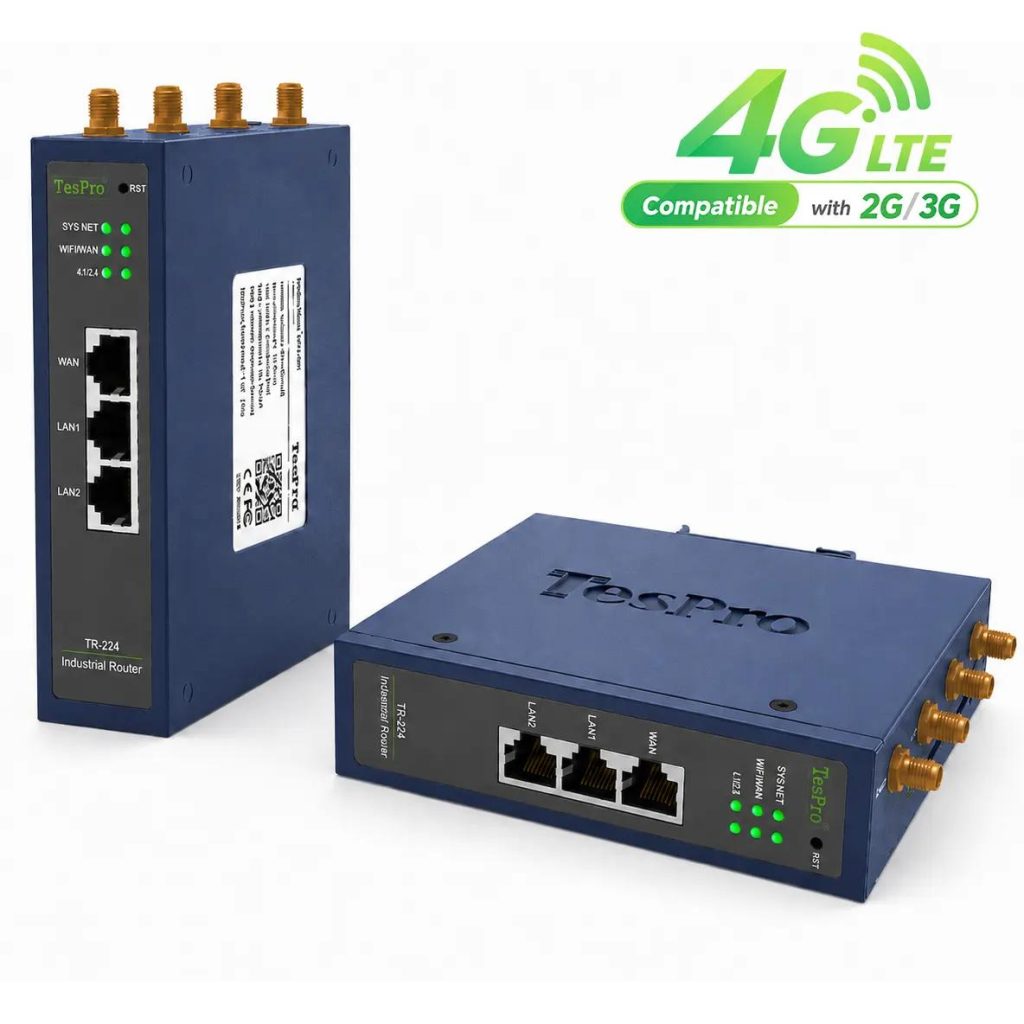
The TR-224 combines industrial cellular connectivity with electrical protection features relevant to remote installations.
| TR-224 Feature | Information | Engineering Consideration |
| Temperature range | -40°C to +75°C | Confirm cold-start operation and high-temperature traffic performance |
| Cellular connectivity | 2G/3G/4G, including LTE | Verify supported bands and operating carrier networks |
| Ethernet | 2 × 10/100 Mbps LAN | Suitable for many telemetry workloads; check required traffic capacity |
| DC input | 12–36V DC | Verify voltage at the router terminals during startup and operation |
| Ethernet protection | Built-in surge protection | Request protection levels and applicable test conditions |
| Power protection | Overvoltage automatic power-off | Clarify cutoff and recovery behavior |
The temperature range does not independently establish resistance to condensation, water ingress, or airborne dust.
Similarly, built-in surge protection should not be confused with complete lightning protection for an exposed industrial installation.
External protective devices, cable routing, grounding, and enclosure selection must be determined from the site's electrical and environmental requirements.
5. How Should Extreme-Temperature Performance Be Qualified?
For remote 4G monitoring, the most relevant qualification metric is whether the router continues delivering usable communication throughout environmental stress.
A practical validation program should cover the following conditions.
| Test | Operating Procedure | Acceptance Focus |
| Cold startup | Power on after low-temperature stabilization | Boot completion and LTE registration |
| High-temperature traffic | Maintain application-representative cellular traffic | Connection stability and unexpected resets |
| Thermal cycling | Repeat transitions between defined temperature limits | Intermittent faults and recovery behavior |
| Power interruption | Restart at temperature extremes | Reliable restoration of application communication |
| Installed cabinet test | Operate alongside actual control equipment | Local temperature and long-term link availability |
Thermal cycling alone does not establish service life. Component aging, mechanical stress, and installation-specific electrical conditions require separate consideration.
Test durations, temperature ramp rates, recovery limits, and acceptance thresholds should be agreed before qualification.
In reproducible cellular testing, controlled radio conditions allow the separation of hardware failures from normal carrier network variation.
6. Where Does the TR-224 Fit in Harsh-Environment Deployments?
The TR-224 is a relevant candidate for 4G-based industrial telemetry, including remote meters, pump controllers, and equipment monitoring stations.
Its two Fast Ethernet LAN ports can support compact local networking arrangements without requiring the higher port density of larger industrial router configurations.
However, thermal capability should not be used as the sole purchasing criterion.
Before specifying the TR-224, verify:
• Compatibility of the carrier frequency-band with respect to local LTE coverage.
• Worst-case temperature inside the enclosure.
• DC power quality and level of surge protection.
• Acceptable time to network reconnection following outages.
• Sealing of the enclosure and condensation control.
• If 5G or additional Ethernet is required, then another Tespro configuration should be considered.
Research the Tespro industrial cellular router line or contact our technical team to review the TR-224 configuration, the environmental qualification and compliance process.
FAQs
Q1. What is the operating temperature range of Tespro TR-224?
Tespro TR-224 has an operating temperature range of -40°C to +75°C for industrial environments.
Q2. Can Tespro TR-224 start at -40°C?
Its operating range extends to -40°C. Cold-start performance and cellular reconnection time should be verified for the specific configuration.
Q3. Does high temperature affect the TR-224's 4G connection?
High temperatures can increase thermal stress on the modem and power circuitry. Sustained LTE performance should be verified under representative traffic loads.
Q4. What power supply does Tespro TR-224 require?
Tespro TR-224 supports 12–36V DC input. Supply stability during startup and cellular transmission should be checked.
Q5. Does Tespro TR-224 support 5G connectivity?
No. TR-224 is a 4G LTE router. Tespro offers separate 5G-capable industrial router models.